 ENG
 INA
International Relations Study Program of Udayana University Collaborates with Universitas Indonesia to Hold a Workshop on Sustainable Tourism in Bali
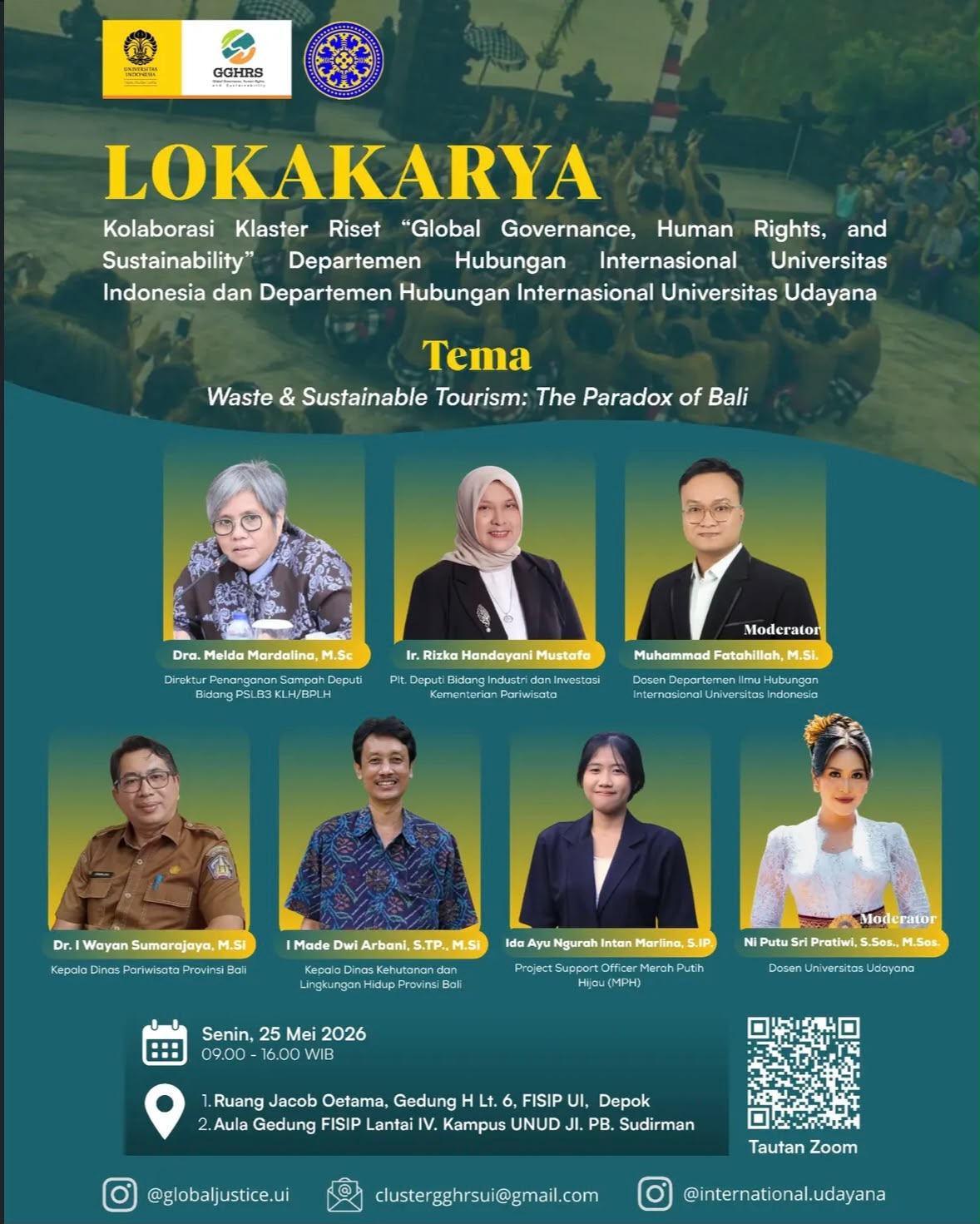
The Global Governance, Human Rights, and Sustainability Research Group, Department of International Relations, Faculty of Social and Political Sciences, Universitas Indonesia, in collaboration with the International Relations Study Program, Faculty of Social and Political Sciences, Udayana University, organized a workshop entitled “Sustainable Tourism in Bali: Environmental, Socio-Cultural, and Governance Challenges” on Monday, May 25, 2026. The event took place from 9:00 AM to 4:00 PM Western Indonesian Time (WIB) at the Cendekia Jakob Utama Room, 6th Floor, Building H, Faculty of Social and Political Sciences, Universitas Indonesia, Depok.
The workshop was organized as a cross-disciplinary platform for critical dialogue on the various challenges of achieving sustainable tourism in Bali. As one of the region's major economic sectors, tourism contributes significantly to local economic development. However, its rapid growth has also generated several challenges, including increasing waste production, coastal ecosystem degradation, land-use conversion, and growing pressure on the living spaces and cultural heritage of Indigenous communities.
The discussions highlighted that environmental issues in Bali cannot be viewed solely as technical challenges related to waste management. These issues are also closely connected to tourism governance, political-economic dynamics, and socio-ecological justice. Therefore, a more comprehensive approach is needed to examine the interconnectedness of tourism growth, waste production, ecosystem pressures, and the sustainability of local communities' socio-cultural life, including challenges surrounding customary land management.
The collaboration between Universitas Indonesia and Udayana University represents an academic contribution to promoting dialogue and exchanging perspectives on the future of tourism in Bali. Through a cross-disciplinary approach, the workshop aimed to deepen understanding of the complexities surrounding tourism while creating opportunities to develop more sustainable ideas and practices.
Through this workshop, participants were expected to develop a shared understanding of the importance of tourism development that goes beyond economic growth by also prioritizing environmental sustainability, socio-cultural protection, and the rights and interests of local communities. Ultimately, sustainable tourism can contribute to a more equitable, inclusive, and sustainable development pathway for Bali.
UDAYANA UNIVERSITY