 ENG
 INA
International Relations Study Program of Udayana University Holds Book Discussion on the Genealogy of Terrorism, Intrusive Systems, and Sovereignty
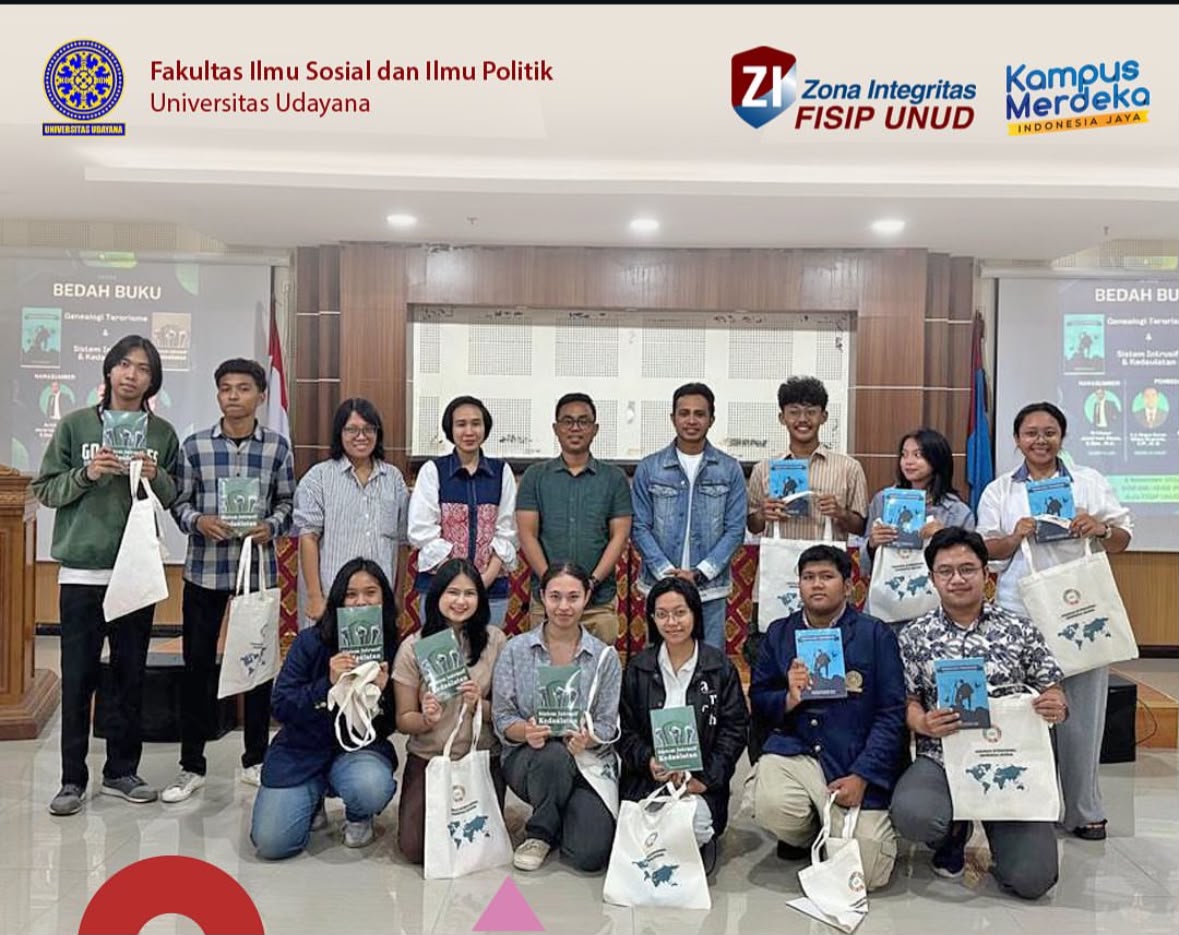
Denpasar – The International Relations Study Program at the Faculty of Social and Political Sciences (FISIP), Udayana University (UNUD), held a book discussion entitled “The Genealogy of Terrorism and Intrusive Systems & Sovereignty” on Wednesday, 6 November 2024. The event took place at the FISIP Auditorium, Sudirman Campus, Udayana University, bringing together academics and practitioners from Indonesian Christian University (UKI) and Udayana University.
The event was attended by students of the International Relations Study Program at Udayana University. Through this academic forum, participants were encouraged to deepen their understanding of the genealogy of terrorism, the concept of intrusive systems, and the relationship between intervention and sovereignty in the field of International Relations.
The discussion featured one speaker from Indonesian Christian University with both academic and professional experience, alongside two discussants from Udayana University. Through presentations and critical discussion, the event provided participants with an opportunity to explore the book’s central arguments and examine their relevance to the development of academic thought and contemporary global politics.
The genealogy of terrorism was one of the key topics explored during the discussion. A genealogical approach examines a phenomenon through its historical development, the evolution of ideas, and the social and political contexts that shape it. From this perspective, terrorism is not understood solely as an act of violence but as a complex phenomenon that requires consideration of the various factors and contexts underlying its emergence.
The concepts of intrusive systems and sovereignty were also central to understanding the dynamics of relations between states. In International Relations, intervention is closely connected to the limits of state authority, the principle of sovereignty, and the legitimacy of external actors’ involvement in a state’s internal affairs. This discussion encouraged students to examine the tension between efforts to maintain security and stability and the need to respect state sovereignty.
Through the book discussion format, students were encouraged not only to understand the text but also to develop critical thinking skills through dialogue and the exchange of perspectives. The interaction among the speaker, discussants, and participants provided an opportunity to examine arguments, broaden perspectives, and connect academic ideas with contemporary issues in international relations.
The event forms part of the International Relations Study Program’s efforts to strengthen academic culture and encourage active student engagement in scholarly discussions. By exploring terrorism, intrusive systems, and sovereignty, students are expected to develop a deeper understanding of the complexities of international security and strengthen their ability to critically analyze global political dynamics.
This book discussion is expected to broaden students’ academic perspectives while fostering greater interest in reading, research, and scholarly dialogue within the International Relations Study Program at Udayana University.
UDAYANA UNIVERSITY