 ENG
 INA
Workshop: Collaboration between the “Global Governance, Human Rights, and Sustainability” Research Cluster of the Department of International Relations at the University of Indonesia and the Department of International Relations at Udayana Univer General
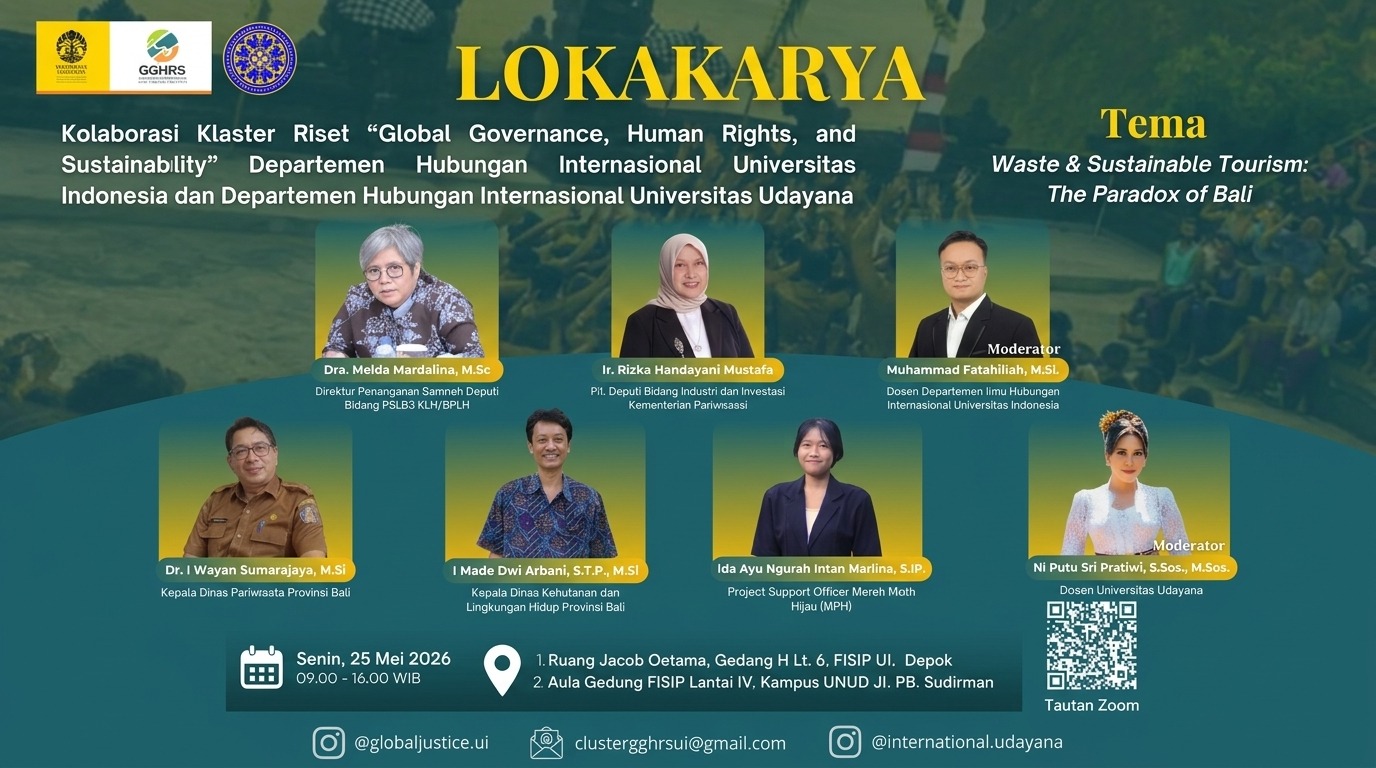
As one of the largest economic sectors, tourism plays a vital role in supporting sustainable development. However, its implementation often presents a paradox: the tension between economic growth and environmental or socio-cultural sustainability. Bali serves as a clear example of this dynamic—while tourism underpins much of the local economy, it has also triggered a waste crisis, the degradation of coastal ecosystems, land-use conversion, and mounting pressure on the living spaces and cultural heritage of indigenous communities. These issues demonstrate that environmental challenges in Bali cannot be viewed merely as technical problems of waste management; rather, they are deeply intertwined with governance, the political economy of tourism, and socio-ecological justice. Against this backdrop, this workshop serves as a space for critical, interdisciplinary dialogue to explore the challenges and the future of sustainable tourism in Bali.
The "Global Governance, Human Rights, and Sustainability" Research Group at the Department of International Relations, Faculty of Social and Political Sciences, Universitas Indonesia—in collaboration with the International Relations Study Program at Udayana University—is organizing a workshop to examine the complex links between tourism growth, waste generation, pressure on ecological systems, and the socio-cultural dynamics of local communities, including the challenges surrounding the management of indigenous (customary) lands. The event will take place as follows:
📅 Monday, May 25, 2026
🕚 09:00–16:00 WIB (Western Indonesian Time)
📍 Jakob Utama Cendekia Room, 6th Floor, Building H, Faculty of Social and Political Sciences (FISIP), Universitas Indonesia, Depok
This workshop is intended to serve as a space for collective reflection, aimed at formulating tourism practices that are more equitable, inclusive, and sustainable—both for the local community and the environment.
UDAYANA UNIVERSITY