 ENG
 INA
International Relations Study Program at FISIP Udayana University Examines State–Business Relations in the Global Development Agenda
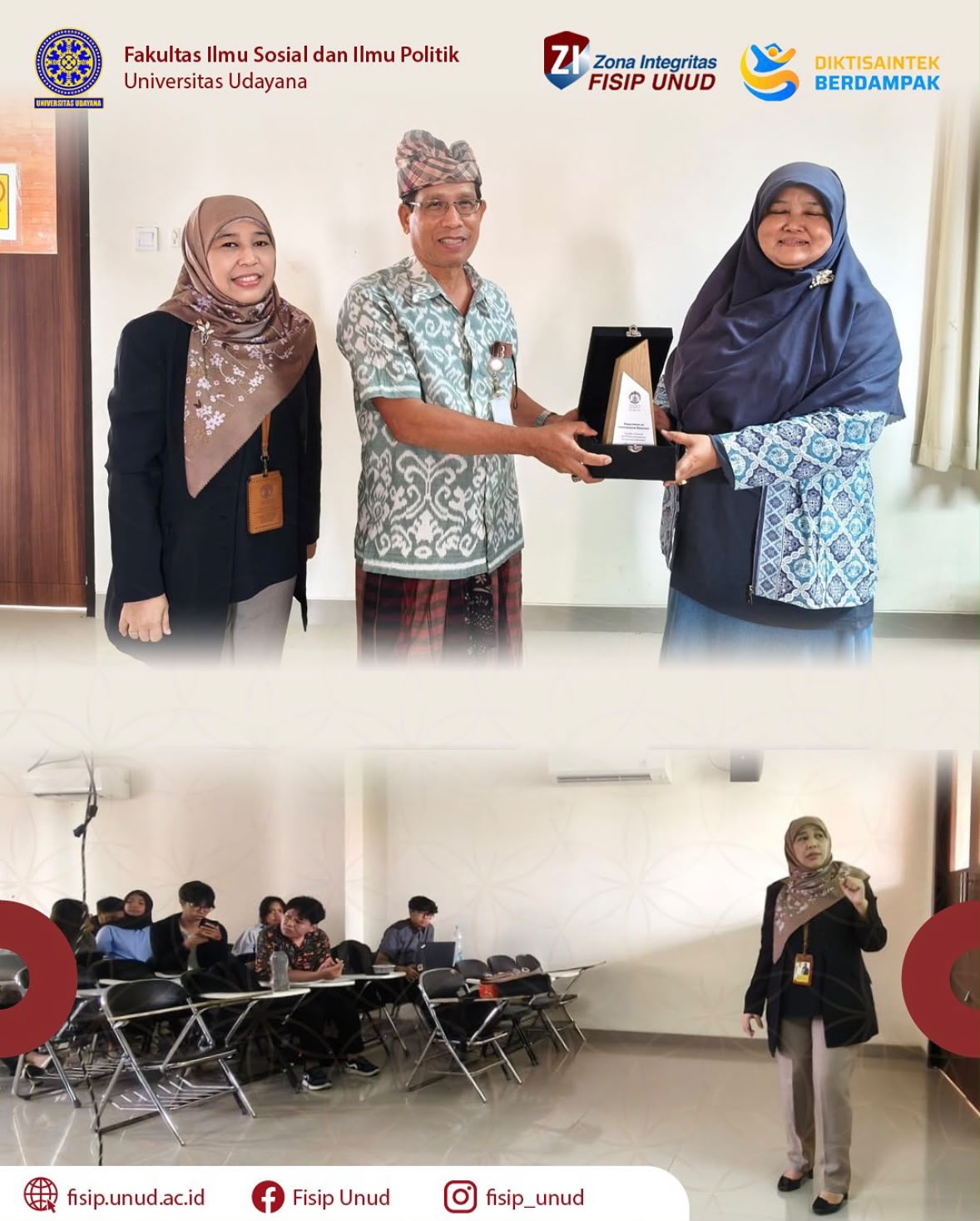
The International Relations Study Program, Faculty of Social and Political Sciences (FISIP), Udayana University, held a guest lecture for the Multinational Corporations (MNCs) and Global Politics course on Thursday, November 6, 2025. The event featured Dr. Asra Virgianita, Ph.D., Associate Professor at the Department of International Relations, Faculty of Social and Political Sciences, Universitas Indonesia, as the guest speaker.
The lecture explored the theme “The Relationship Between the State and Business in Achieving the Global Development Agenda”, examining how states and the business sector interact in supporting global development objectives. The discussion focused on the strategic roles of states and multinational corporations (MNCs), while critically addressing the challenges that may arise from their interactions, particularly in achieving the Sustainable Development Goals (SDGs).
In her presentation, Dr. Asra Virgianita encouraged students to critically examine how interactions between states and multinational corporations influence policy directions and the implementation of global development initiatives. Although both actors can contribute to achieving the SDGs, their relationship may also present challenges, particularly when economic interests and public interests are not aligned.
The discussion was enriched by several theoretical perspectives in global politics, including Neoliberal Institutionalism, the Developmental State, and State Capitalism. These perspectives provided students with analytical frameworks for examining the respective roles of states and businesses in development, as well as the interactions among government policies, corporate interests, and global economic mechanisms.
Beyond theoretical discussions, the guest lecture addressed contemporary issues relevant to state–business relations, including climate change, digital monopolies, and potential conflicts of interest. These issues highlighted the complexity of global development and the importance of understanding the relationships between state and non-state actors in addressing cross-border challenges.
Students demonstrated strong enthusiasm through active participation in the discussion session, raising critical and reflective questions. This engagement played an important role in deepening their understanding and connecting classroom theories with real-world challenges in global politics.
Through this guest lecture, the International Relations Study Program at FISIP Udayana University continues to promote critical learning that responds to contemporary global developments. The event is expected to broaden students’ perspectives on the roles of states and multinational corporations in the global development agenda while strengthening their analytical skills in understanding the challenges of achieving the SDGs at the international level.
UDAYANA UNIVERSITY