 ENG
 INA
International Relations Study Program of Udayana University Holds Workshop on the Relevance and Transformation of the OBE Curriculum within the Impactful Campus Framework
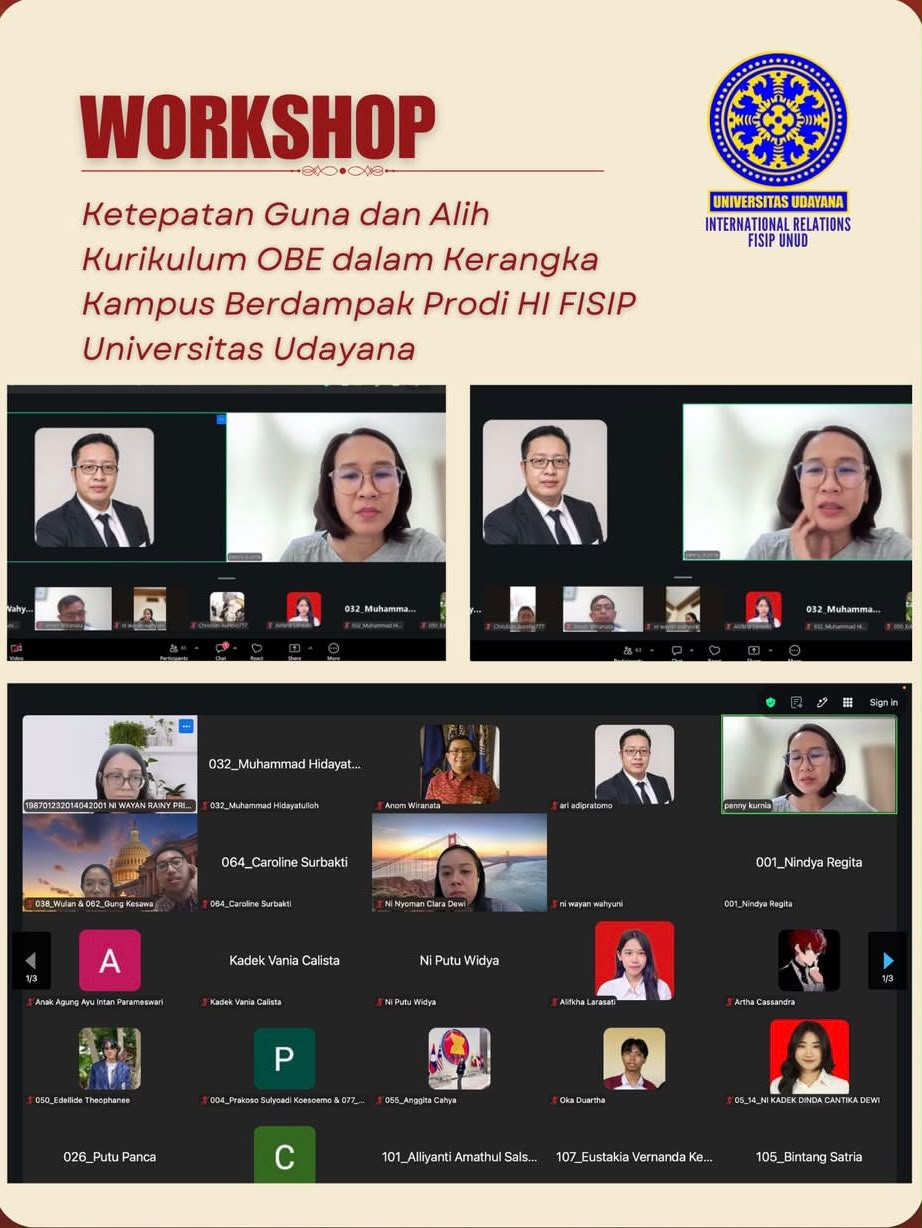
The International Relations Study Program, Faculty of Social and Political Sciences, Udayana University, held a workshop entitled “The Relevance and Transformation of the OBE Curriculum within the Impactful Campus Framework” on Monday, September 14, 2026. The workshop was part of the study program's efforts to evaluate and develop its Outcome-Based Education (OBE) curriculum to ensure greater relevance to societal needs and professional demands.
The workshop featured Ari Adi Pratomo, a Climate Leader from The Climate Reality Project, as the speaker. In his presentation, he provided insights from the graduate-user perspective regarding the competencies and qualifications required in the professional world. These perspectives served as valuable input for the International Relations Study Program in developing and adapting its OBE curriculum towards a curriculum that emphasizes tangible outcomes and meaningful impact.
The workshop highlighted the importance of aligning graduate learning outcomes with demands beyond the academic environment. The curriculum is expected not only to equip students with theoretical knowledge but also to develop practical abilities, professional skills, and the capacity to respond to various societal challenges.
Through this activity, the International Relations Study Program, Faculty of Social and Political Sciences, Udayana University, seeks to strengthen the relevance of its curriculum to graduate-user expectations while supporting the implementation of the Impactful Campus concept. This curriculum development initiative is expected to produce graduates who are not only academically competent but also capable of applying their knowledge and making positive contributions to professional environments and society.
The workshop represents a strategic step towards fostering a more adaptive higher education system that responds to real-world needs. Ultimately, the success of a curriculum should not be measured solely by the learning materials delivered in the classroom, but also by the contributions and positive impact that graduates bring to society.
UDAYANA UNIVERSITY